“We need to do something with AI” is now a line item in most marketing plans. It is also the reason a lot of teams are about to waste a quarter. Here is a grounded view of what marketing agents do in the Salesforce ecosystem today — and how to pilot one without betting anything important on it.
Key takeaways
- Marketing agents are scoped assistants, not autonomous marketers. Their usefulness comes from narrow scope.
- The ready use cases today are the boring ones: drafting, summarising, segment suggestion, campaign QA.
- Grounding decides quality. An agent without good grounding produces fluent, confident, wrong output.
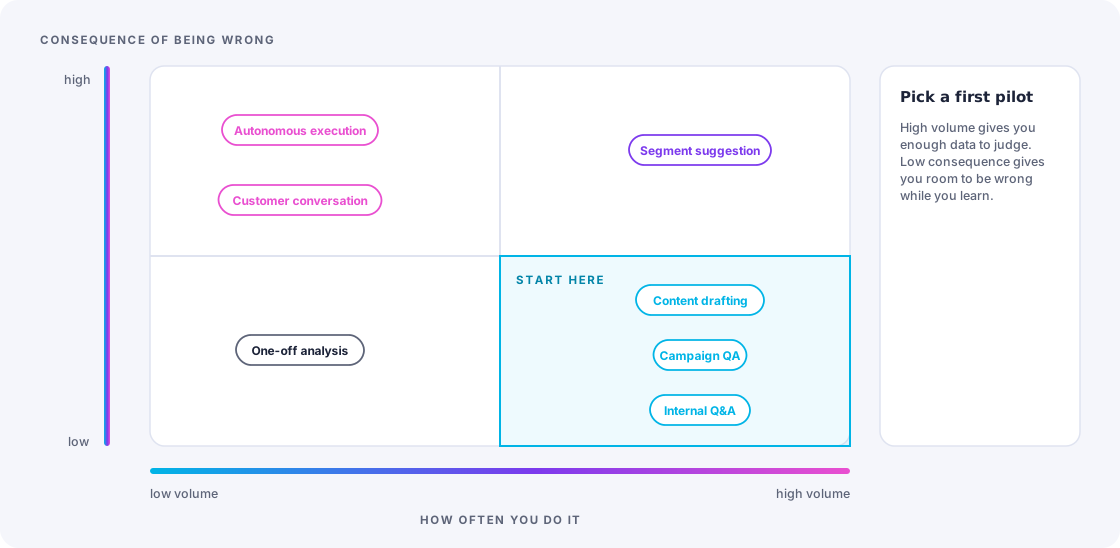
- Pilot on something high-volume and low-consequence, with a human in the loop and a defined success metric.
- Write down the off switch before you turn it on.
What an agent actually is
Strip away the framing and an agent is four things: a scope (the topics it may handle), a set of actions (what it may do), a body of grounding (what it knows), and guardrails (how it must behave and when it must stop).
None of those is intelligence. All four are configuration decisions you make. An agent that behaves well does so because someone scoped it narrowly, grounded it in curated content, gave it a short list of permitted actions, and defined what it must refuse.
This matters for expectation-setting. “Can the agent run our campaigns?” is the wrong question. “What is one job we do repeatedly, at volume, where a wrong answer is cheap to correct?” is the right one.
Where agents genuinely help today
The honest list is less exciting than the keynote and more useful.
| Use case | Why it works | Readiness |
|---|---|---|
| Content drafting | High volume, human always reviews, wrong output costs a minute | Ready now |
| Campaign QA | Checklist work against explicit rules — links, fallbacks, alt text, tone | Ready now |
| Segment suggestion | Proposes a definition a human approves before it runs | Ready now, with a review step |
| Summarising engagement | Turns activity history into a briefing for a rep or a marketer | Ready now |
| Answering internal questions | Grounded in your own documentation, forgiving audience | Ready now — the best first pilot |
| Customer-facing conversation | Needs escalation design, disclosure, adversarial testing | Possible, but not a first project |
| Autonomous campaign execution | Broad scope, write actions, hard to constrain | Not a sensible near-term goal |
Grounding is the whole ballgame
The failure mode of an under-grounded agent is specific and worth internalising: it does not say “I do not know.” It produces a fluent, well-structured, entirely invented answer, delivered with the same confidence as a correct one.
That is why grounding coverage is a launch gate rather than a nice-to-have. Three practical consequences:
- Curate before you connect. A knowledge base nobody has reviewed for two years will confidently quote discontinued products and superseded policies. If no one will own a corpus, exclude it.
- Test the gaps deliberately. Your test set must include questions the grounding cannot answer, to confirm the agent declines rather than improvises. Ten of your fifty test questions should be unanswerable.
- Watch for drift. Grounding decays as content ages. Someone needs a recurring job to re-check it, or quality degrades invisibly over months.
Stale content is worse than missing content
A missing answer produces a refusal, which is recoverable. A stale answer produces confident misinformation attributed to your brand, which is not. Before grounding a corpus, name its owner.
Running a first pilot
The pattern that consistently works is deliberately unambitious:
- Pick one job, internal if possible. An agent answering colleague questions from your own documentation gives you the full learning curve with a forgiving audience and no brand exposure.
- Build the test set before the agent. Fifty real questions from real tickets or real conversations, each with the correct answer written next to it, plus ten the agent should refuse.
- Define the success metric up front. Deflection rate, first-response time, or task completion — with the number that counts as success agreed before launch, so nobody decides retrospectively.
- Run it shadowed. Agent drafts, human reviews and sends, for long enough to see the real failure modes rather than the imagined ones.
- Flip only the subset that passes. Autonomy is granted per topic based on evidence, not granted wholesale because the pilot “went well.”
- Review weekly for a month, then monthly. Transcripts, refusals, escalations, and the metric.
The off switch
Before launch, write down exactly how to disable the agent, who is allowed to do it, and how long it takes. Then test it. An organisation that cannot turn something off in five minutes will not be comfortable turning it on — and that discomfort is entirely rational.
What to measure, and what not to
Agent pilots get evaluated badly more often than they fail. Two traps:
Measuring enthusiasm instead of outcomes. “The team loves it” is not a result. Pick a number that would have moved anyway if the agent were useful — time to draft, tickets deflected, QA defects caught before send — and track it against a period before the agent existed.
Measuring only successes. The refusal rate and the escalation rate are as informative as the completion rate. An agent that never refuses is over-confident; one that refuses constantly is under-grounded. Both are fixable, and neither shows up if you only count wins.
The honest position on readiness
Agentic capability in the Salesforce ecosystem is moving quickly, and the distance between the keynote and the release notes is real. That is not a reason to sit out — but it is a reason to pick use cases where being early is cheap.
A well-scoped agent doing one high-volume job, grounded in content someone owns, with a real escalation path and an off switch, is a genuinely useful thing to have running today. An ambitious agent with broad topics and write permissions, launched to prove the organisation is innovative, is a governance incident waiting for a slow news week.
The teams that will be good at this in two years are the ones building the boring disciplines now: content ownership, test sets, review cadence. Those transfer to every future capability. The specific agent you ship this quarter probably will not.
Frequently asked
Seeing this in your own org?
The first call is free: thirty minutes, no slides, and an honest read on what a fix would take. If it is not worth doing, you will hear that too.